Longtime women’s and magazine editor Sabrina Weill may have left the magazine business, but she still wants to be part of the club. Speaking to a packed room of NYU Journalism students, Weill stresses the importance of networking in a business that can be based more on who you know than you ever knew, and offers advice for making it in magazines.
“There’s an inside and an outside,” Weill says, “and it’s better to be on the inside. Using your connections will not get you a job – but it will put your resume at the top of the pile.”
Weill is the former editor-in-chief of Seventeen, senior editor at Redbook and a founding editor of CosmoGIRL!, as well as published author of The Seventeen Guide to Sex and Your Body and last year’s The Real Truth About Teens and Sex. She recently jumped ship from the magazine masthead to start her own company, Weill Media. But this auburn-haired, 30-something CEO with Lisa Loeb glasses admits that she misses her monthlies, and she still likens each new website her company launches with publishing a brand-new magazine.
Thursday, January 11, 2007

This is a little late, but...
I have had limited internet access lately, and I felt that this story was still worth putting up (since it's not like anyone reads this anyway and I haven't posted in so long as it is):
Thanksgiving is fast approaching – which means that Christmas music will be taking over radio stations for the next month and colorful decorations have lined the streets since Halloween. ‘Tis the season to shop. But before you go to Tower Records’ Going-Out-of-Business sale to get your annual fix of Bing Crosby, Nat King Cole or A Charlie Brown Christmas, consider walking across East 4th street to the other music store on the block.
Other Music, a small record store located on East 4th and Lafayette streets, offers alternatives to the typical holiday tunes (as well as any other genre, from Turkish psychedelia to Japanese surf rock) while catering to the music aficionados that flock there. Although you might find a copy of Mariah Carey’s perennial best-seller Merry Christmas hidden on the shelves, the biggest release this season will likely be indie-music king Sufjan Stevens’ Songs for Christmas.
“People who shop here aren’t really into the typical Christmas albums,” says Other Music store clerk Duane Harriott. “Mostly they’re looking for quirky stuff. It’s more fun than it is sacred.”
As a result, Harriott says, Other Music’s most popular Christmas collections are predictably offbeat. James Brown’s Funky Christmas makes a resurgence every year. Rudy Ray Moore, a.k.a. “Dolemite,” released This Ain’t No White Christmas in 1986, and his notoriously dirty version of “Night Before Christmas” has kept it in stock for the past two decades. Harriott’s personal favorite, though, is A Reggae Christmas, featuring holiday classics as interpreted by 60s and 70s reggae stars like Desmond Dekker, The Kingstonians and Studio Three.
But Other Music counts on its customers to look beyond the Top 40, or even the changing seasons, for their particular musical tastes. As Tower Records shuts its doors and other music chains struggle to survive, Harriott does not expect a surge in crossover Christmas purchases. “The people who shop here know us,” he says. “They already know that we’re here.”
Thanksgiving is fast approaching – which means that Christmas music will be taking over radio stations for the next month and colorful decorations have lined the streets since Halloween. ‘Tis the season to shop. But before you go to Tower Records’ Going-Out-of-Business sale to get your annual fix of Bing Crosby, Nat King Cole or A Charlie Brown Christmas, consider walking across East 4th street to the other music store on the block.
Other Music, a small record store located on East 4th and Lafayette streets, offers alternatives to the typical holiday tunes (as well as any other genre, from Turkish psychedelia to Japanese surf rock) while catering to the music aficionados that flock there. Although you might find a copy of Mariah Carey’s perennial best-seller Merry Christmas hidden on the shelves, the biggest release this season will likely be indie-music king Sufjan Stevens’ Songs for Christmas.
“People who shop here aren’t really into the typical Christmas albums,” says Other Music store clerk Duane Harriott. “Mostly they’re looking for quirky stuff. It’s more fun than it is sacred.”
As a result, Harriott says, Other Music’s most popular Christmas collections are predictably offbeat. James Brown’s Funky Christmas makes a resurgence every year. Rudy Ray Moore, a.k.a. “Dolemite,” released This Ain’t No White Christmas in 1986, and his notoriously dirty version of “Night Before Christmas” has kept it in stock for the past two decades. Harriott’s personal favorite, though, is A Reggae Christmas, featuring holiday classics as interpreted by 60s and 70s reggae stars like Desmond Dekker, The Kingstonians and Studio Three.
But Other Music counts on its customers to look beyond the Top 40, or even the changing seasons, for their particular musical tastes. As Tower Records shuts its doors and other music chains struggle to survive, Harriott does not expect a surge in crossover Christmas purchases. “The people who shop here know us,” he says. “They already know that we’re here.”
Wednesday, November 15, 2006
A Talk With Dan Barry
“When I hang out with my college buddies, what do my friends want to do?” New York Times columnist Dan Barry asks a room full of New York University journalism students. “They want to hear what I did, not talk about their jobs at General Electric or Ernst & Young.”
Barry, 48, is a former ditch-digger turned columnist who graduated NYU with a master’s degree in journalism. He has been writing for the Times since 1995, and his “About New York” column has appeared in each Wednesday and Saturday’s paper since 2003. In his column, Barry tends to focus on the stories that capture a moment in the city, seemingly small moments that often serve as microcosms to explain New York as a whole. And even though he has written about the tragedies of September 11 and Hurricane Katrina, you only see tears in his eyes when he talks about the actress who serves wine and cheese dressed as the Statue of Liberty, at the Marriott in Queens; or when he tells the story of a man who saved a stranger’s life, pulling him out of the water to safety in Coney Island and hugging surrounding New Yorkers after the danger had passed. Barry remembers every intimate detail so well that you believe the tale could be his own.
“The only thing worse than a story poorly told,” Barry says, “is a story untold. If you get inside the skin of a person, you can open up the world.”
Look around Barry’s office, and you will see assorted framed certificates on the walls – among them a George Polk Award, a Pulitzer Prize, an American Society of Newspaper Editors Award for deadline reporting. But one day Barry opened his mail to find a 5th place certificate for “Dan Berry,” with a $150 check enclosed, from the Bowling Writers of America for a feature story that he did not even know had been submitted to any contest. The certificate and the check were promptly framed and added to the wall.
“I like to write about funny moments,” Barry says. “I’ve written so much about tragedy and loss that I look forward to those stories.”
Barry, 48, is a former ditch-digger turned columnist who graduated NYU with a master’s degree in journalism. He has been writing for the Times since 1995, and his “About New York” column has appeared in each Wednesday and Saturday’s paper since 2003. In his column, Barry tends to focus on the stories that capture a moment in the city, seemingly small moments that often serve as microcosms to explain New York as a whole. And even though he has written about the tragedies of September 11 and Hurricane Katrina, you only see tears in his eyes when he talks about the actress who serves wine and cheese dressed as the Statue of Liberty, at the Marriott in Queens; or when he tells the story of a man who saved a stranger’s life, pulling him out of the water to safety in Coney Island and hugging surrounding New Yorkers after the danger had passed. Barry remembers every intimate detail so well that you believe the tale could be his own.
“The only thing worse than a story poorly told,” Barry says, “is a story untold. If you get inside the skin of a person, you can open up the world.”
Look around Barry’s office, and you will see assorted framed certificates on the walls – among them a George Polk Award, a Pulitzer Prize, an American Society of Newspaper Editors Award for deadline reporting. But one day Barry opened his mail to find a 5th place certificate for “Dan Berry,” with a $150 check enclosed, from the Bowling Writers of America for a feature story that he did not even know had been submitted to any contest. The certificate and the check were promptly framed and added to the wall.
“I like to write about funny moments,” Barry says. “I’ve written so much about tragedy and loss that I look forward to those stories.”
Monday, November 13, 2006
Untitled
It has gradually come to my attention that "New York Notebook," aside from already being taken by more prolific bloggers than myself, is a lame and cliche title for a blog - especially a blog like this, which is not essentially a notebook, and may or may not be limited to New York-themed topics. Therefore, this blog will remain untitled for the time being. Or the indefinite future. Or permanently. Whatever.
Sunday, November 12, 2006
Not Just Another Girl With a Guitar: Deidre Muro Makes Music Her Business
This article was recently published in the November 10-12 issue of New York University's Washington Square News:
I woke up early this morning,
Didn’t know who I was,
Your heavy head still on my pillow.
You exhale, stale with alcohol.
If someone had told me that this is how
Love would all go down,
(‘Cause it’s going down)
Then they may have saved me from your touch.
-Deidre Muro, “Red Afternoon” Standing onstage with her guitar and sipping a rum and coke, a faint smile spreads across Deidre Muro’s face as the spotlight fades. Halfway through her set at the East Village’s Sidewalk Café, the last notes of her brooding reflections on lost love seem to hang in the air for a moment before rising applause takes over the candlelit room.
“One of the coolest things about playing music in front of a crowd is the ability to shut up a room,” Muro said over coffee and a bagel at Café Pick Me Up a few days before the show. “When I play ‘Red Afternoon,’ sometimes it’s scary how quiet the room gets. Suddenly everyone is on the same page with me.”
Muro, a 21-year-old NYU senior, is a petite girl with short brown hair, a disarming smile and a big voice that belies her small stature. She channels the singing voice of Ella Fitzgerald, the songwriting of Jeff Buckley, and the soul of Muddy Waters – all with the help of her long-time backing band, which includes her brother Derek Muro on guitar, Zach Abramson on bass and piano, Mike Christy on drums and Drew Olsen on the cello. But Muro said not to confuse her with those Michelle Branch/Ani DiFranco “girl with a guitar” types spreading their white noise all over the radio.
“I hate the term ‘singer-songwriter’,” she said, “even though I suppose that’s what I am and I’m not trying to hide that. But it’s become a genre, and as a genre it’s so stuck in whiny, lame-ass acoustic shit. I like to think I’m more varied than that. I mean most people will say they say like all types of music, but I’m seriously into so much different stuff that it’s even confusing to me, and more than what I might want to play musically, I have to figure out what’s right for my voice. So I realized I’m not very suited to rock, but jazz works for me.”
Muro was raised in Smithtown, Long Island, by a mother who is a church organist and choir director, and a father who is a long-time writer and teacher on the subject of synthesizers and electronic music. As a result, Muro grew up with a love of music, attending her mother’s choir practices as a baby, and later joining the choir herself at the age of seven. She also watched every movie musical she could find – including her favorites by Rogers & Hammerstein – and sang those same tunes for hours while her father accompanied on piano.
In high school, she and her brother Derek began writing “silly little pop/rock songs” together, which eventually led to the formation of their alt-rock band, The Token. Derek, two years Deidre’s senior, graduated high school shortly after the band was formed. He attended Manhattan School of Music where he met current drummer Christy, and would return occasionally for shows at local dive bars and Battles of the Bands.
“I was so nervous at those first shows,” she said. “I don’t really get tense like that anymore, but I remember feeling very nervous. But once we got started, I was like, ‘This is fucking awesome. I want to do this all the time!’”
The Token played throughout Muro’s high school career, but broke up the summer after her senior year. She took a break from performing until her sophomore year at the Steinhardt School of Education – where she is majoring in music business – to focus on her studies and what she now recognizes as a “bad relationship.” Once she started writing a few new songs on her own, however, Muro decided that she wanted to record her first album.
“I don’t just spit out songs,” she said. “I have to wait for them to come. Sometimes months will pass and I won’t write a single song. Other times they come out all at once. But I can’t force myself to sit down and write.”
Muro released Red Afternoon in December of 2004. The album, produced and engineered by her brother, is a collection of songs recorded over three years, dating back to her days at Smithtown High School and up to her sophomore fall semester.
But she is constantly changing her sound. She tests out new material at New York venues like the Bitter End and Crash Mansion, and incorporates new instruments such as the melodica (“It looks like I’m playing a duck with a keyboard on its back.”), while also keeping a few of her old tunes on reserve.
“I don’t want to get up and whine about my life in front of people anymore,” Muro said. “It got to the point where there were songs I was uncomfortable playing. And when you can’t even feel comfortable playing your own songs, that’s a shitty situation.”
To remedy that, Muro took another break from playing for almost a year while she focused on writing new music. Since then, she has come up with some of her strongest material to date, departing from her alt-rock beginnings in favor of jazz and blues.
“My new songs are not really about me,” Muro revealed. “They’re more abstract I guess. It’s easier for me to perform, because I basically feel like I’m acting a part. With the older songs I was too involved; I couldn’t remove myself enough from them to just have fun and perform.”
Muro debuts several of her new songs – which are set to be released as a six-song EP sometime within the next month – during her show at Sidewalk. With lyrics like “There’s blood on her hands/ No weapons to blame/ She killed another man/ You know it’s always been/ A dangerous game” (from “Blood on Her Hands”), you trust that Muro is writing bluesy fiction rather than her memoirs, at least for now; with perpetual change, who knows?

“More than wanting to do it,” Muro says of her musical motivation, “I feel like I have an obligation, like I have to do it. And that’s not from outside pressure, and it’s not just because it’s in my blood, but I just feel like music is what I’m supposed to do."
Deidre Muro’s debut album Red Afternoon is available for download at iTunes or CDBaby.com, or by mail at www.deidremuro.com. Listen to sample clips online at www.myspace.com/deidremuro.
I woke up early this morning,
Didn’t know who I was,
Your heavy head still on my pillow.
You exhale, stale with alcohol.
If someone had told me that this is how
Love would all go down,
(‘Cause it’s going down)
Then they may have saved me from your touch.
-Deidre Muro, “Red Afternoon”
 Standing onstage with her guitar and sipping a rum and coke, a faint smile spreads across Deidre Muro’s face as the spotlight fades. Halfway through her set at the East Village’s Sidewalk Café, the last notes of her brooding reflections on lost love seem to hang in the air for a moment before rising applause takes over the candlelit room.
“One of the coolest things about playing music in front of a crowd is the ability to shut up a room,” Muro said over coffee and a bagel at Café Pick Me Up a few days before the show. “When I play ‘Red Afternoon,’ sometimes it’s scary how quiet the room gets. Suddenly everyone is on the same page with me.”
Muro, a 21-year-old NYU senior, is a petite girl with short brown hair, a disarming smile and a big voice that belies her small stature. She channels the singing voice of Ella Fitzgerald, the songwriting of Jeff Buckley, and the soul of Muddy Waters – all with the help of her long-time backing band, which includes her brother Derek Muro on guitar, Zach Abramson on bass and piano, Mike Christy on drums and Drew Olsen on the cello. But Muro said not to confuse her with those Michelle Branch/Ani DiFranco “girl with a guitar” types spreading their white noise all over the radio.
“I hate the term ‘singer-songwriter’,” she said, “even though I suppose that’s what I am and I’m not trying to hide that. But it’s become a genre, and as a genre it’s so stuck in whiny, lame-ass acoustic shit. I like to think I’m more varied than that. I mean most people will say they say like all types of music, but I’m seriously into so much different stuff that it’s even confusing to me, and more than what I might want to play musically, I have to figure out what’s right for my voice. So I realized I’m not very suited to rock, but jazz works for me.”
Muro was raised in Smithtown, Long Island, by a mother who is a church organist and choir director, and a father who is a long-time writer and teacher on the subject of synthesizers and electronic music. As a result, Muro grew up with a love of music, attending her mother’s choir practices as a baby, and later joining the choir herself at the age of seven. She also watched every movie musical she could find – including her favorites by Rogers & Hammerstein – and sang those same tunes for hours while her father accompanied on piano.
In high school, she and her brother Derek began writing “silly little pop/rock songs” together, which eventually led to the formation of their alt-rock band, The Token. Derek, two years Deidre’s senior, graduated high school shortly after the band was formed. He attended Manhattan School of Music where he met current drummer Christy, and would return occasionally for shows at local dive bars and Battles of the Bands.
“I was so nervous at those first shows,” she said. “I don’t really get tense like that anymore, but I remember feeling very nervous. But once we got started, I was like, ‘This is fucking awesome. I want to do this all the time!’”
The Token played throughout Muro’s high school career, but broke up the summer after her senior year. She took a break from performing until her sophomore year at the Steinhardt School of Education – where she is majoring in music business – to focus on her studies and what she now recognizes as a “bad relationship.” Once she started writing a few new songs on her own, however, Muro decided that she wanted to record her first album.
“I don’t just spit out songs,” she said. “I have to wait for them to come. Sometimes months will pass and I won’t write a single song. Other times they come out all at once. But I can’t force myself to sit down and write.”
Muro released Red Afternoon in December of 2004. The album, produced and engineered by her brother, is a collection of songs recorded over three years, dating back to her days at Smithtown High School and up to her sophomore fall semester.
But she is constantly changing her sound. She tests out new material at New York venues like the Bitter End and Crash Mansion, and incorporates new instruments such as the melodica (“It looks like I’m playing a duck with a keyboard on its back.”), while also keeping a few of her old tunes on reserve.
“I don’t want to get up and whine about my life in front of people anymore,” Muro said. “It got to the point where there were songs I was uncomfortable playing. And when you can’t even feel comfortable playing your own songs, that’s a shitty situation.”
To remedy that, Muro took another break from playing for almost a year while she focused on writing new music. Since then, she has come up with some of her strongest material to date, departing from her alt-rock beginnings in favor of jazz and blues.
“My new songs are not really about me,” Muro revealed. “They’re more abstract I guess. It’s easier for me to perform, because I basically feel like I’m acting a part. With the older songs I was too involved; I couldn’t remove myself enough from them to just have fun and perform.”
Muro debuts several of her new songs – which are set to be released as a six-song EP sometime within the next month – during her show at Sidewalk. With lyrics like “There’s blood on her hands/ No weapons to blame/ She killed another man/ You know it’s always been/ A dangerous game” (from “Blood on Her Hands”), you trust that Muro is writing bluesy fiction rather than her memoirs, at least for now; with perpetual change, who knows?

“More than wanting to do it,” Muro says of her musical motivation, “I feel like I have an obligation, like I have to do it. And that’s not from outside pressure, and it’s not just because it’s in my blood, but I just feel like music is what I’m supposed to do."
Deidre Muro’s debut album Red Afternoon is available for download at iTunes or CDBaby.com, or by mail at www.deidremuro.com. Listen to sample clips online at www.myspace.com/deidremuro.
Wednesday, November 01, 2006
Radio, Radio
“Some stories are so aural that the sound is more important than the narration,” journalist John Kalish explains about his long career in radio. Now in his 50s, balding but with a full gray beard and wearing suspenders over a long-sleeve T-shirt, Kalish has worked as a freelance radio reporter for nearly three decades. In that time, he has covered such diverse subjects as the homeless, Brookyln’s Orthodox Jewish culture, the deaf community, and the arts, among others – and each of his stories has been uniquely suited to the radio format.
Take his piece about “Industrial Musicals,” for example. The story of a long-forgotten (if ever even publicly known) series of musicals commissioned by corporations in the middle of the twentieth century could have been described colorfully in the pages of a newspaper. But hearing these unique American artifacts for yourself elicits first mockery, then appreciation and admiration, for songs about life insurance and car parts and home appliances, in a way that could never be understood without the full aural experience.
Kalish has been able to maintain a career as a full-time freelance reporter, simply by paying attention to the world around him and the often-overlooked details of everyday life. He takes very few assignments and prefers to work on the stories that he finds himself. “I’ve developed a way to walk around in the world with my eyes and ears open and my antennae up,” Kalish says.
Take his piece about “Industrial Musicals,” for example. The story of a long-forgotten (if ever even publicly known) series of musicals commissioned by corporations in the middle of the twentieth century could have been described colorfully in the pages of a newspaper. But hearing these unique American artifacts for yourself elicits first mockery, then appreciation and admiration, for songs about life insurance and car parts and home appliances, in a way that could never be understood without the full aural experience.
Kalish has been able to maintain a career as a full-time freelance reporter, simply by paying attention to the world around him and the often-overlooked details of everyday life. He takes very few assignments and prefers to work on the stories that he finds himself. “I’ve developed a way to walk around in the world with my eyes and ears open and my antennae up,” Kalish says.
Tuesday, October 31, 2006
A Fond Farewell
Matthew Ross, the now-former managing editor of Filmmaker Magazine, has left for LA to pursue his own filmmaking career. Jason Guerrasio is Filmmaker's new managing editor. As a sort of tribute, here is a piece I wrote about Mr. Ross last year:
The managing editor of Filmmaker Magazine sits amid the steady hum of computers in his spacious but windowless office, having just completed work on the spring issue of “the magazine of independent film,” three months in the making.
Matthew Ross, 30, has been the managing editor of Filmmaker since he joined the magazine in 2003. He is one of only two staff editors at a magazine that reaches over 60,000 readers each issue, many of whom are filmmakers themselves.
As managing editor, Ross oversees all production, content and photo shoots; acts as chief contact for the magazine’s editorial staff, writers, publisher, designer and advertising director; represents the magazine at film industry events and film festivals; and, of course, writes features and reports for the magazine.
“While we’re in production, which takes place about three weeks every three months,” Ross says, “I’m sort of like the assistant director or production manager of the magazine. The rest of the time, I’m finding stories for us to cover.”
Born and raised in Manhattan, Ross attended Harvard University, where he studied film production and graduated in 1998 with a Bachelor of Arts degree in Visual and Environmental Studies. Like many of his colleagues at the magazine, Ross is also an aspiring filmmaker. His short film Curtis and Clover premiered at the 2001 Hamptons International Film Festival, where it was nominated for the Golden Starfish Award. He recently completed another short film, Lola, which should hit the festival circuit later this year.
Ross sees his career in journalism as part of a balancing act, a way to pay the bills while he simultaneously works on his career as a filmmaker.
“Writing and directing movies is never a hirable job at the start,” Ross says. “I’ve always loved writing – especially writing about movies. Writing about movies was the one thing I knew could do right off the bat.”
Immediately after graduation, Ross went to Los Angeles, where he briefly worked for Dimension Films and Miramax Films and found freelance production work on various documentaries. But, he says, “I wanted something more intellectually stimulating. I kind of fell into journalism by accident.”
Ross wrote for several online publications during the dot com boom, including Directors World, EditorsNet and 2-pop. Less than a year later, however, the boom went bust and he found a job at Variety.
He returned to New York as a staff film reporter, but says now that even though he loved working for Variety, he “didn’t want to be a business reporter.” Ross left Variety in January of 2002 and soon began working for indieWIRE Publications, where he was senior editor, overseeing all editorial content.
He left indieWire at the end of 2002 and began working for Filmmaker shortly thereafter.
“It was time to leave,” he says. “I was always a huge fan of Filmmaker. Plus, a quarterly magazine offered a more flexible schedule.”
While at Filmmaker, Ross has continued to write freelance articles for Variety, the Village Voice, indieWire and the Criterion Collection, among other publications. He has written and will be directing his first feature film, Plays Well with Others, with Cynthia Nixon attached to star, and is already working on his second feature, a psychological thriller titled Frank & Lola.
“Filmmaker has been very good to me,” Ross says. “But my ultimate ambition is to make films.”
The managing editor of Filmmaker Magazine sits amid the steady hum of computers in his spacious but windowless office, having just completed work on the spring issue of “the magazine of independent film,” three months in the making.
Matthew Ross, 30, has been the managing editor of Filmmaker since he joined the magazine in 2003. He is one of only two staff editors at a magazine that reaches over 60,000 readers each issue, many of whom are filmmakers themselves.
As managing editor, Ross oversees all production, content and photo shoots; acts as chief contact for the magazine’s editorial staff, writers, publisher, designer and advertising director; represents the magazine at film industry events and film festivals; and, of course, writes features and reports for the magazine.
“While we’re in production, which takes place about three weeks every three months,” Ross says, “I’m sort of like the assistant director or production manager of the magazine. The rest of the time, I’m finding stories for us to cover.”
Born and raised in Manhattan, Ross attended Harvard University, where he studied film production and graduated in 1998 with a Bachelor of Arts degree in Visual and Environmental Studies. Like many of his colleagues at the magazine, Ross is also an aspiring filmmaker. His short film Curtis and Clover premiered at the 2001 Hamptons International Film Festival, where it was nominated for the Golden Starfish Award. He recently completed another short film, Lola, which should hit the festival circuit later this year.
Ross sees his career in journalism as part of a balancing act, a way to pay the bills while he simultaneously works on his career as a filmmaker.
“Writing and directing movies is never a hirable job at the start,” Ross says. “I’ve always loved writing – especially writing about movies. Writing about movies was the one thing I knew could do right off the bat.”
Immediately after graduation, Ross went to Los Angeles, where he briefly worked for Dimension Films and Miramax Films and found freelance production work on various documentaries. But, he says, “I wanted something more intellectually stimulating. I kind of fell into journalism by accident.”
Ross wrote for several online publications during the dot com boom, including Directors World, EditorsNet and 2-pop. Less than a year later, however, the boom went bust and he found a job at Variety.
He returned to New York as a staff film reporter, but says now that even though he loved working for Variety, he “didn’t want to be a business reporter.” Ross left Variety in January of 2002 and soon began working for indieWIRE Publications, where he was senior editor, overseeing all editorial content.
He left indieWire at the end of 2002 and began working for Filmmaker shortly thereafter.
“It was time to leave,” he says. “I was always a huge fan of Filmmaker. Plus, a quarterly magazine offered a more flexible schedule.”
While at Filmmaker, Ross has continued to write freelance articles for Variety, the Village Voice, indieWire and the Criterion Collection, among other publications. He has written and will be directing his first feature film, Plays Well with Others, with Cynthia Nixon attached to star, and is already working on his second feature, a psychological thriller titled Frank & Lola.
“Filmmaker has been very good to me,” Ross says. “But my ultimate ambition is to make films.”
You Can't Make a Film on Your Own
“We were just starting out at the time, making short films, and we felt that there must be a better way to make a film than calling and begging people for help and money,” says producer Jess Search of the humble beginnings of Shooting People, the London-based online community of independent filmmakers. Search and fellow filmmaker Cath Le Couteur founded Shooting People in the U.K. in 1998, and the first U.S. branch launched in New York in 2004. The organization expanded to include Los Angeles and San Francisco on May 15 of this year.
Shooting People began as a free online network, with about 60 of Search and Le Couteur’s friends as its first members, but started charging membership fees three years ago. Search says that only about 30 percent of their members shifted to the pay model initially and that they have yet to make a profit in the U.K., but over time they were able to attract more new members and expand their services. Now there are over 29,000 “Shooters” in the U.K. and U.S., where for an annual fee of $40 members can find and develop scripts, cast and crew their films, and get advice from other Shooters throughout the filmmaking process.
“I was coming to New York a lot, so I knew it and I saw that there was a comparable indie scene there,” Search explains. “I was actually surprised there wasn’t already something like Shooting People in New York.” Los Angeles seemed liked the next logical step, and depending on the group’s success there Search and Le Couteur will consider taking Shooting People to more locations worldwide.
However, to be most useful Shooting People needs to be more than just a phantasmagoric network of e-mails and online message boards. To that end Ingrid Kopp, who is in charge of Shooting People in the U.S., has started to introduce programs similar to those offered to U.K. members - such as "Shooter socials" and guest speakers - to expand the group’s North American presence. And Shooting People’s Mobile Cinema, already an annual hit in the U.K., will soon launch in the U.S. on a two-week cross-country tour from New York to Los Angeles, stopping wherever they are called along the way to screen the best of their members’ short films.
“The idea of Shooting People is so simple,” Kopp says, “but it can go so far. There’s much more we can do.”
Search and Le Couteur have recently become as concerned with the challenges of independent film distribution as they are with its production. As a result, Shooting People recently launched Word of Mouth, its new DVD label, and released its first title Best v Best, a collection of international award-winning shorts available only in the UK. Word of Mouth will also release the upcoming DVD for Rupert Murray’s 2005 documentary Unknown White Male, which was co-produced by Search.
“We’re really proud of the model we’ve developed,” Search says. “Shooting People is self-sustaining, created by filmmakers for filmmakers.”
For more information about Shooting People or to become a member, visit www.shootingpeople.org.
Shooting People began as a free online network, with about 60 of Search and Le Couteur’s friends as its first members, but started charging membership fees three years ago. Search says that only about 30 percent of their members shifted to the pay model initially and that they have yet to make a profit in the U.K., but over time they were able to attract more new members and expand their services. Now there are over 29,000 “Shooters” in the U.K. and U.S., where for an annual fee of $40 members can find and develop scripts, cast and crew their films, and get advice from other Shooters throughout the filmmaking process.
“I was coming to New York a lot, so I knew it and I saw that there was a comparable indie scene there,” Search explains. “I was actually surprised there wasn’t already something like Shooting People in New York.” Los Angeles seemed liked the next logical step, and depending on the group’s success there Search and Le Couteur will consider taking Shooting People to more locations worldwide.
However, to be most useful Shooting People needs to be more than just a phantasmagoric network of e-mails and online message boards. To that end Ingrid Kopp, who is in charge of Shooting People in the U.S., has started to introduce programs similar to those offered to U.K. members - such as "Shooter socials" and guest speakers - to expand the group’s North American presence. And Shooting People’s Mobile Cinema, already an annual hit in the U.K., will soon launch in the U.S. on a two-week cross-country tour from New York to Los Angeles, stopping wherever they are called along the way to screen the best of their members’ short films.
“The idea of Shooting People is so simple,” Kopp says, “but it can go so far. There’s much more we can do.”
Search and Le Couteur have recently become as concerned with the challenges of independent film distribution as they are with its production. As a result, Shooting People recently launched Word of Mouth, its new DVD label, and released its first title Best v Best, a collection of international award-winning shorts available only in the UK. Word of Mouth will also release the upcoming DVD for Rupert Murray’s 2005 documentary Unknown White Male, which was co-produced by Search.
“We’re really proud of the model we’ve developed,” Search says. “Shooting People is self-sustaining, created by filmmakers for filmmakers.”
For more information about Shooting People or to become a member, visit www.shootingpeople.org.
Thursday, October 26, 2006
Tom Sykes at Barnes & Noble
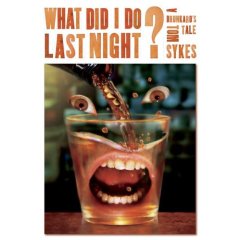 "The thing I miss about drinking is getting absolutely, mind-blowingly drunk," says Tom Sykes, a former writer and editor for such varied publications as British GQ and the New York Post, among many others, and now the author of What Did I Do Last Night? A Drunkard’s Tale. "But nothing else. Not the mysteriously empty bank account, not waking up hung over in the morning, not the fear that my wife is going to leave me."
Speaking with a thick British accent in the cramped music section of a Barnes & Noble in Chelsea, the youthful Sykes reveals, with humorous candor, his unlikely transition from accomplished journalist to unemployed alcoholic to author of his own drunken memoirs. After he was "fired from every newspaper in London," including the Daily Telegraph and the Evening Standard, Sykes worked for British GQ, where colleagues at first found his hard-drinking lifestyle humorous – but soon his lies and excuses for his behavior became a source of aggravation.
Sykes then came to New York in 2003 to write freelance for the New York Post and other publications. At the Post, he edited a bar column titled “Block Party” and a dating column called “Meet Market,” and contributed to the famous gossip column “Page Six.” Partying had become his career.
When he finally realized that his alcoholism had taken over and was threatening to destroy his entire life, Sykes says that he stopped drinking “cold turkey” and saw life improve dramatically (“I do look completely different. I used to be green.”). But since his career was based on alcohol, he was suddenly out of a job. So he sought out any opportunity to write again.
Writing about getting sober was the last thing he wanted to do. Although Sykes says that he found writing What Did I Do Last Night? a cathartic process, there were some interesting challenges along the way. “There were bits and pieces I didn’t remember,” Sykes says of his alcohol-drenched nights, then releases a self-deprecating laugh. “I would go further. There were some bits and pieces I do remember.”
Thursday, October 19, 2006
A Talk with Robert Lipsyte
On the heels of a national book tour for his tenth young adult novel, longtime sportswriter and author Robert Lipsyte discusses what he has learned (or rather, what has been reaffirmed) by speaking with students in his recent travels to schools and libraries. “Jock culture” is alive and well, according to Lipsyte – but that’s precisely the problem.
“The separation of jocks and geeks never ends,” Lipsyte says. “Most presidents, senators and surgeons are jocks. The president, our asshole-in-chief, is the kind of guy who would shoulder kids in the hallways; now he shoulders small countries. Clinton always wants a mulligan. Rumsfeld is a bully on the squash court.”
Lipsyte sees the social constructs that have been created in middle school and high school hallways and locker rooms continuing well past graduation. One might think that Robert Lipsyte, who is approaching his sixty-ninth birthday and speaks softly due to his use of a hearing aide (even while he often talks and acts like a man half his age), would have long ago forgotten the bullies and nerds of his youth. But as many of his readers and countless more Americans know, the lessons learned on the sports field and locker rooms can have a greater impact than those in the classroom.
As Lipsyte has observed with the long-running but unspoken popularity of steroids, the rapid inflation of professional sports contracts, and even his own experiences with certain New York Times editors, jock culture in sports affects all of American culture as a whole. It should come as no surprise that a man who claims to have never been a sports fan (“I’m not uninterested, just disinterested,” he says) would be critical not only of the athletes involved, but of our entire sports-oriented culture.
“The separation of jocks and geeks never ends,” Lipsyte says. “Most presidents, senators and surgeons are jocks. The president, our asshole-in-chief, is the kind of guy who would shoulder kids in the hallways; now he shoulders small countries. Clinton always wants a mulligan. Rumsfeld is a bully on the squash court.”
Lipsyte sees the social constructs that have been created in middle school and high school hallways and locker rooms continuing well past graduation. One might think that Robert Lipsyte, who is approaching his sixty-ninth birthday and speaks softly due to his use of a hearing aide (even while he often talks and acts like a man half his age), would have long ago forgotten the bullies and nerds of his youth. But as many of his readers and countless more Americans know, the lessons learned on the sports field and locker rooms can have a greater impact than those in the classroom.
As Lipsyte has observed with the long-running but unspoken popularity of steroids, the rapid inflation of professional sports contracts, and even his own experiences with certain New York Times editors, jock culture in sports affects all of American culture as a whole. It should come as no surprise that a man who claims to have never been a sports fan (“I’m not uninterested, just disinterested,” he says) would be critical not only of the athletes involved, but of our entire sports-oriented culture.
Subscribe to:
Posts (Atom)